

 ITA
ITA  ENG
ENG SPAN
SPAN FR
FR NL
NL GER
GER FI
FI

 ENG
ENG  ITA
ITA Siemens Desigo CC alternatives: light BMS and remote building control
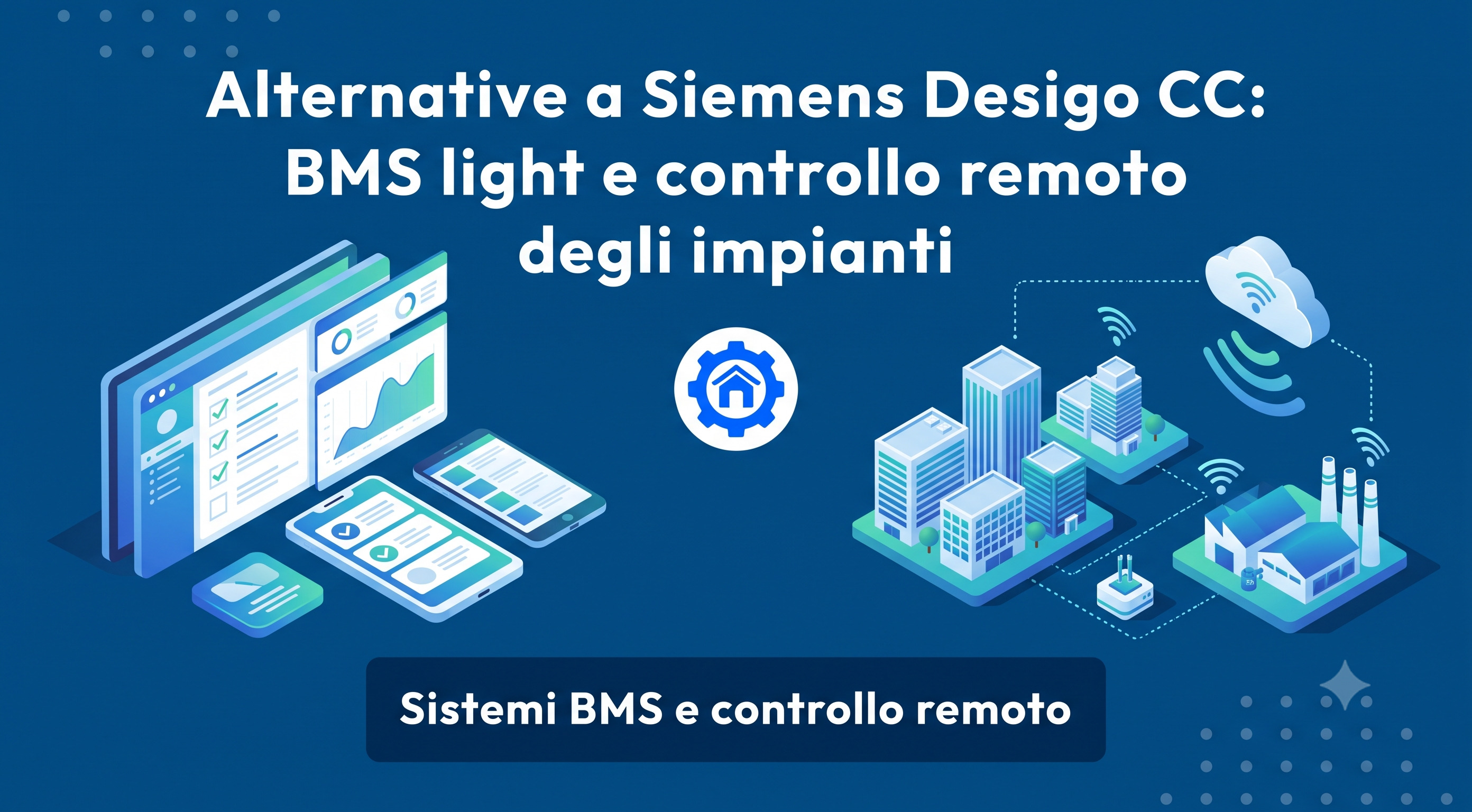
Desigo CC is Siemens' building management platform for complex buildings: one of the global benchmarks in its category. For this very reason it is not the right choice everywhere:
for a small-to-medium building, or for a portfolio of sites to be managed remotely, its complexity and costs are rarely justified. In this guide we look at the alternatives, including the route that is often the most convenient: not replacing it, but integrating it.
A note on transparency: UTwin, which you will find among the alternatives, is our own software. We state this upfront, along with one firm point: UTwin is not a head-on competitor to the large BMS platforms like Desigo CC. It covers the properties where a full BMS has never been justifiable, and it integrates with existing ones where remote control is needed.
In brief:
- Desigo CC performs best where system complexity is high: hospitals, campuses, headquarters, data centers.
- For a small-to-medium building or a portfolio of sites, engineering and cabling costs rarely pay off.
- The most common scenario is not replacement: it is a BMS that exists, monitors alarms and has logic frozen at commissioning.
- In that case, integration puts the system back to work without touching the existing infrastructure.
What Desigo CC does (and what it does well)
According to Siemens documentation, Desigo CC is a modular integrated management platform, which the manufacturer states is suitable for buildings of any size and which performs best where system complexity is high: hospitals, campuses, headquarters, data centers. The documented features:
- Multi-domain integration: HVAC, energy, lighting, fire protection, security and access control governed by a single platform.
- One of the broadest protocol supports on the market: BACnet and BACnet/SC, Modbus, KNX, OPC UA and others, with BACnet certifications on advanced profiles.
- Scalability: a single system manages up to 150,000 objects, with distributed configurations going beyond that.
- On-premise architecture with cloud: client-server core installed on site and native connectivity to the Siemens Building X cloud platform in recent versions.
For the hospital, campus or data center with critical systems and a dedicated technical team, Desigo CC is exactly the right tool. The alternatives are for those who don't fit that picture.
When it makes sense to consider an alternative
The most frequent scenarios are not about the limits of the platform, but about the gap between its scale and the actual building:
- The building doesn't justify a full BMS. For stores, supermarkets, hotels, nursing homes and small head offices, cabling, engineering and system integrators weigh too heavily against the value of the property: this is why these buildings often remain managed by hand.
- You manage a portfolio, not a single building. Ten small sites are not a tenth of a campus: you need cloud, centralized remote management and fast site-by-site installations.
- You need data, AI and maintenance, more than systems supervision. If the goal is to cut consumption and link anomalies to interventions, multi-vector monitoring, automations and CMMS matter more than control of complex plant rooms.
- The BMS is already there, but it is underused. This is the most common scenario of all: the system exists, monitors alarms, and its logic is frozen at commissioning. In this case the right question is not 'what do I replace it with?' but 'how do I put it back to work?'.
Desigo CC alternatives compared
The alternatives fall into two families: the other large BMS platforms, for those who stay within the realm of the complex building, and the light BMS, for those outside it. The name of each system links to our dedicated in-depth article; the complete picture is in the BMS guide.
| System | Profile | When to choose it |
|---|---|---|
| EcoStruxure Building Operation Schneider Electric | Open BMS of the EcoStruxure platform, with native BACnet, LonWorks and Modbus and cloud analytics | Complex buildings, particularly where the electrical ecosystem is already Schneider |
| EBI and Niagara Honeywell | EBI for large complexes with integrated security and fire protection; Niagara as a vendor-neutral framework | Large infrastructures with a strong need for security integration |
| module and Vision Center SAUTER | Universal multi-protocol automation and supervision at management level | Multi-system commercial and healthcare buildings in Europe |
| UTwin (light BMS) | Cloud platform with supplied wireless sensors, AI that regulates systems remotely, CMMS and digital twin | Small-to-medium buildings and multi-site portfolios where a full BMS isn't justified |
The light alternative: when a full BMS isn't justified
A light BMS like UTwin brings the essential functions of a building management system (monitoring, automations, remote regulation) without the infrastructure of a traditional system: smart meters and wireless sensors supplied directly and installed without cabling or business downtime, AI that regulates systems based on outdoor weather and the actual occupancy of spaces, and a native CMMS that links consumption to maintenance.
For building types such as retail, supermarkets, hotels, nursing homes and small head offices, the investment is up to 70% lower than a traditional BMS. It is not a Desigo CC in miniature: it is a different tool, proportioned to buildings that would never have had a full BMS.
Alternative or integration? UTwin alongside Desigo CC
Where Desigo CC is already installed and governs complex systems, replacing it rarely makes sense: the value lies in integration. In several projects we have integrated UTwin with the existing BMS precisely to activate what was missing: continuous reading of energy data, remote automations based on weather and occupancy, and the link between anomalies and work orders.
The BMS continues to do its job on local control of the systems; UTwin adds the layer of data, AI and maintenance that often remains unused in the control room. It is also the fastest way to put an underused system back to work without touching the existing infrastructure.
How to choose
The criterion we see working in projects is to start from the building, not from the system:
- How complex are your systems really? Complex boiler rooms, critical rooms and integrated systems justify a structured BMS; standard systems do not.
- What is already there and how is it used? An existing, underused BMS is an asset to integrate, not a cost to replicate.
- Who will manage the system? An on-site technical team or centralized multi-site remote management? The answer points toward on-premise or cloud.
- Over what horizon are you evaluating costs? CAPEX, cabling and system integrators on one side; cloud subscription and wireless sensors on the other. The correct comparison is over five or ten years, on an equal scope.
Frequently asked questions
- Is Desigo CC suitable for small buildings too?
Siemens states that its modular platform is suitable for buildings of any size, so the limit is not the software. It is the project underneath it: for a small building or a portfolio of small sites, engineering and cabling costs rarely pay off, and this is the context in which the light alternative was born.
- Can I keep Desigo CC and add UTwin?
Yes, and it is often the best route: the BMS continues to control the systems locally, while UTwin integrates and adds multi-vector monitoring, remote AI automations and the link with maintenance. No replacement, no system downtime.
- How much does a traditional BMS cost?
As an industry order of magnitude, we are talking about an investment of between 300 and 1,200 euros per control point, or between 8 and 25 euros per square meter turnkey, plus annual maintenance. These figures refer to traditional BMS in general, not to a specific price list: it is the scale of the investment that explains why small-to-medium buildings are left out.
- What is the difference between a BMS and a light BMS?
The traditional BMS is a wired, on-site installed system designed to govern complex systems. The light BMS is a cloud platform with wireless sensors that delivers the essential functions (monitoring, automations, remote regulation) with a much lower investment and much shorter installation times. They are not in competition: they cover different buildings.
- Our BMS is underused: is it worth replacing it?
Almost never. First it is worth understanding why it is limited to alarms (logic never updated, missing skills, data that never leaves the control room) and evaluating an integration that unlocks its value: it is faster, less risky and much cheaper than a replacement.
Where to start
Start with the inventory: which buildings you have, which already have a BMS and how it is actually used, which have never had one. That picture tells you where a system like Desigo CC is needed, where a light platform is enough and where the right move is an integration. The rest is a comparison of offers, on an equal scope.


Informative Material