

 ITA
ITA  ENG
ENG SPAN
SPAN FR
FR NL
NL GER
GER FI
FI

 ENG
ENG  ITA
ITA Schneider EcoStruxure: an alternative and integration for remote building control
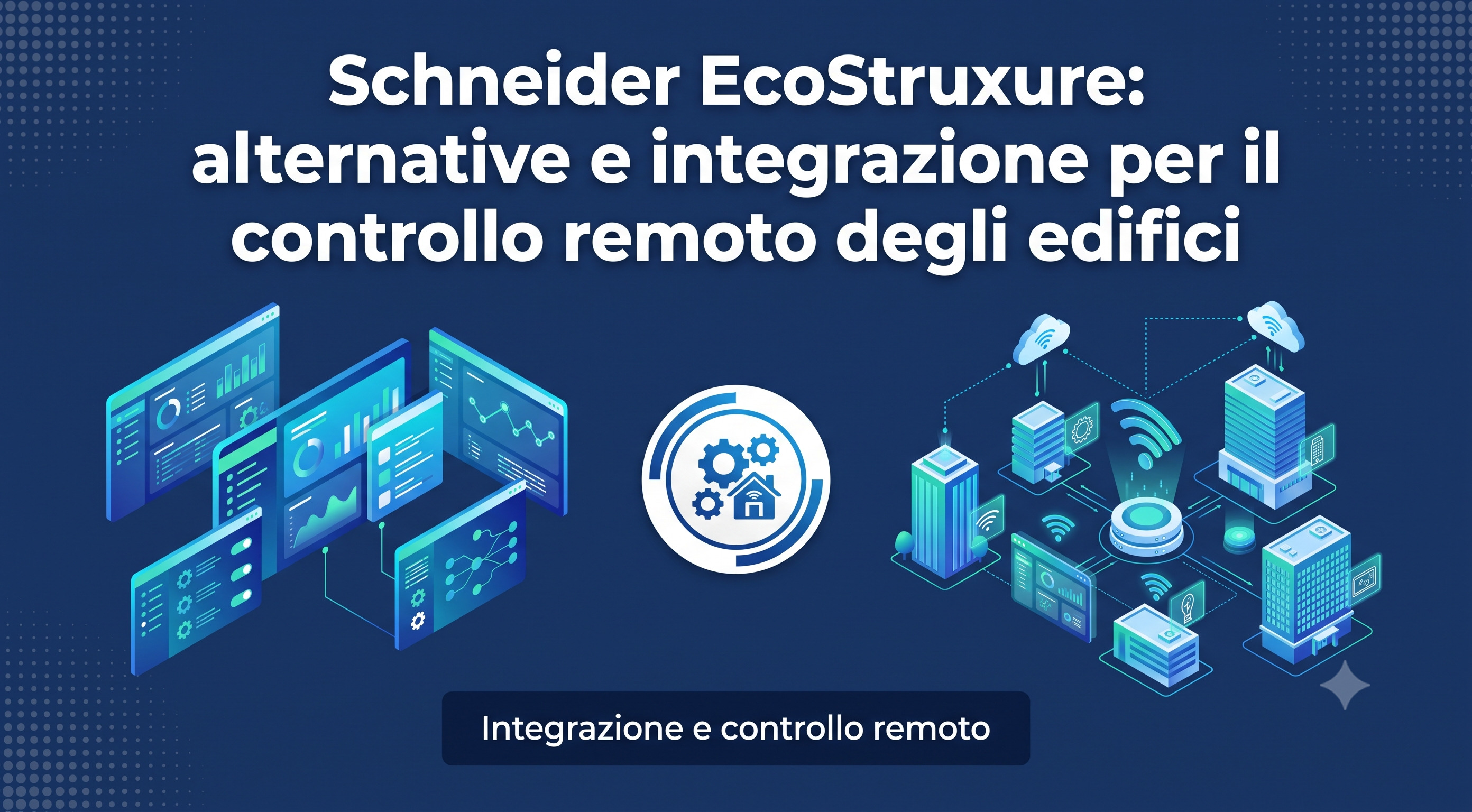
EcoStruxure is Schneider Electric's building management platform and one of the world's leading solutions for building automation. Those who use it or are considering it usually are not looking for a replacement:
they are looking for a way to bring data, automation and remote control to their entire portfolio, including buildings that will never need a full BMS. In this guide, we first look at integration, the approach we know best, and then at alternatives for those outside its scope.
For transparency: UTwin is our software, and it does not compete with EcoStruxure; it integrates with it. The integration is documented and field-validated, and we describe it below. For the rest of the comparison, we also indicate, as always, the situations in which UTwin is not the right choice.
In brief:
- EcoStruxure Building Operation is Schneider's open BMS, with native BACnet, LonWorks and Modbus support.
- UTwin does not compete with EcoStruxure: the integration between the two platforms is documented and field-validated.
- For an installation already in operation, integration adds multi-utility monitoring, remote automation and a CMMS.
- Alternatives come into play for buildings and portfolios that will never have a full BMS.
What EcoStruxure Building Operation does (and what it does well)
According to Schneider Electric's documentation, EcoStruxure Building Operation is the BMS within the EcoStruxure platform, with the following characteristics:
- Support for open standard protocols: native BACnet, LonWorks and Modbus, plus IoT sensor integration via MQTT and web services.
- Three-layer architecture: field devices, edge control and cloud services, with analytics and energy services delivered by the platform's cloud layer.
- Schneider ecosystem: natural integration with the group's electrical distribution and power management, a tangible advantage in buildings where the electrical panel already uses Schneider equipment.
It is positioned for commercial and critical buildings: multi-tenant offices, healthcare facilities and data centers. Within this scope, it is one of the most robust platforms on the market.
EcoStruxure + UTwin: integration for remote control
Let's start with the approach we have actually implemented. UTwin integrates with EcoStruxure: BMS data flows in real time into the building's digital twin, together with energy consumption and environmental parameters. The same platform enables remote actions, such as switching off lighting and air conditioning or setting automatic rules based on real conditions such as outdoor weather and space occupancy.
The integration was validated in a pilot project at a Schneider Electric site and is now available to all customers: we announced it here.
What integration adds to an EcoStruxure installation already in operation: multi-utility monitoring for energy, water, gas and environmental conditions in one environment, remote AI automation, and a native CMMS that turns an anomaly in consumption into a work order.
The BMS continues to control building systems locally; UTwin adds the layer for data, intelligence and maintenance. For those with an underused BMS limited to alarms in the control room, it is also the fastest way to put it to work without changing the infrastructure.
When it makes sense to consider an alternative
Alternatives come into play when a building or portfolio falls outside the natural scope of a full BMS:
- Buildings that will never have a full BMS. Retail stores, supermarkets, hotels, residential care facilities and smaller corporate offices: cabling and engineering costs do not pay off, so these properties continue to be managed manually.
- Multi-site portfolios that need remote management. Many small sites need cloud services, rapid installation and centralized management more than site-by-site building-system supervision.
- Environments with a different ecosystem. If building systems and specifications already use another manufacturer's products, the comparison should be between equivalent major BMS platforms.
EcoStruxure alternatives compared
As with every major BMS, the alternatives fall into two groups: comparable systems at the same level and lightweight BMS solutions for those outside their scope. Each system name links to our dedicated in-depth article; the full overview is available in the BMS guide.
| System | Profile | When to choose it |
|---|---|---|
| Desigo CC Siemens | Modular platform for highly complex buildings, with one of the broadest protocol support ranges on the market | Hospitals, campuses, headquarters and data centers with critical building systems |
| EBI and Niagara Honeywell | EBI for large complexes with integrated security and fire protection; Niagara as a vendor-neutral framework | Large infrastructures with strong security integration requirements |
| module and Vision Center SAUTER | Universal multi-protocol automation and supervision at the management level | Commercial and healthcare buildings with multiple systems in Europe |
| UTwin (lightweight BMS) | Cloud platform with supplied wireless sensors, AI for remote system adjustment, CMMS and digital twin | Small and medium-sized buildings and multi-site portfolios where a full BMS is not justified |
The lightweight alternative: when a full BMS is not justified
For buildings outside the scope of major BMS platforms, a lightweight BMS such as UTwin provides essential functions (monitoring, automation and remote adjustment) without the infrastructure of a traditional system: smart meters and wireless sensors supplied directly and installed without cabling or operational downtime, AI that adjusts systems according to outdoor weather and actual space occupancy, and an integrated CMMS.
For sites such as retail stores, supermarkets, hotels, residential care facilities and smaller corporate offices, the investment can be up to 70% lower than with a traditional BMS. In mixed portfolios, both approaches can coexist: EcoStruxure where the building systems require it, and a lightweight BMS at smaller sites, with UTwin providing a single data layer above both.
How to choose
In real-world portfolios, the choice is rarely an either-or decision; it is a map. These are the criteria we see working in projects:
- Classify the buildings, not the system. Which sites have building systems that justify a full BMS, which already have one that is underused, and which will never have one?
- Decide where the data will reside. A portfolio should be managed from a single environment: choose the platform that aggregates consumption, automation and maintenance across all sites.
- Make the most of what is already installed. An operating EcoStruxure system is an asset: integration costs a fraction of replacement and unlocks the value already paid for.
- Compare costs over the right time horizon. CAPEX, cabling and system integrators versus a cloud subscription and wireless sensors: the right comparison covers five or ten years, with the same scope.
Frequently asked questions
- Does UTwin integrate with Schneider Electric's EcoStruxure?
Yes. The integration brings BMS data into UTwin's digital twin in real time and enables remote control of building systems, with automatic rules based on weather and occupancy. It was validated in a pilot project at a Schneider Electric site and is available to all customers.
- Is EcoStruxure also suitable for small buildings?
Its documented focus is on commercial and critical buildings: multi-tenant offices, healthcare facilities and data centers. For a small building or a portfolio of smaller sites, the engineering and cabling costs of a full BMS rarely pay off: this is where a lightweight BMS makes sense.
- Do I need to replace EcoStruxure to get remote control and AI?
No. This is exactly the situation in which integration is worthwhile. The BMS continues to control building systems locally, while the integrated platform adds multi-utility monitoring, remote automation and maintenance connectivity, without downtime or rebuilding the infrastructure.
- What is the difference between EcoStruxure and a lightweight BMS?
They serve different types of buildings. EcoStruxure is a full BMS for complex buildings, with in-depth building-system control and integration with Schneider's electrical ecosystem. A lightweight BMS is a cloud platform with wireless sensors for buildings that do not justify a full BMS. Both can coexist in a mixed portfolio.
- How much does integrating an existing BMS cost compared with replacing it?
Integration works on top of the existing infrastructure: no new cabling or controller replacement is required, so the cost is only a fraction of a complete replacement. Costs include the platform subscription and any additional sensors; the comparison should consider the value unlocked from the system already paid for.
Where to start
Map your portfolio: identify where EcoStruxure or another BMS is already installed and how it is being used, and where there is no BMS and there never will be one. This overview makes the options clear: integrate where infrastructure already exists, use a lighter solution where a full BMS is not justified, and bring data from every site into one environment.


Informative Material