

 ITA
ITA  ENG
ENG SPAN
SPAN FR
FR NL
NL GER
GER FI
FI

 ENG
ENG  ITA
ITA ISO 50001: what it is, requirements, and how to obtain Energy Management System certification
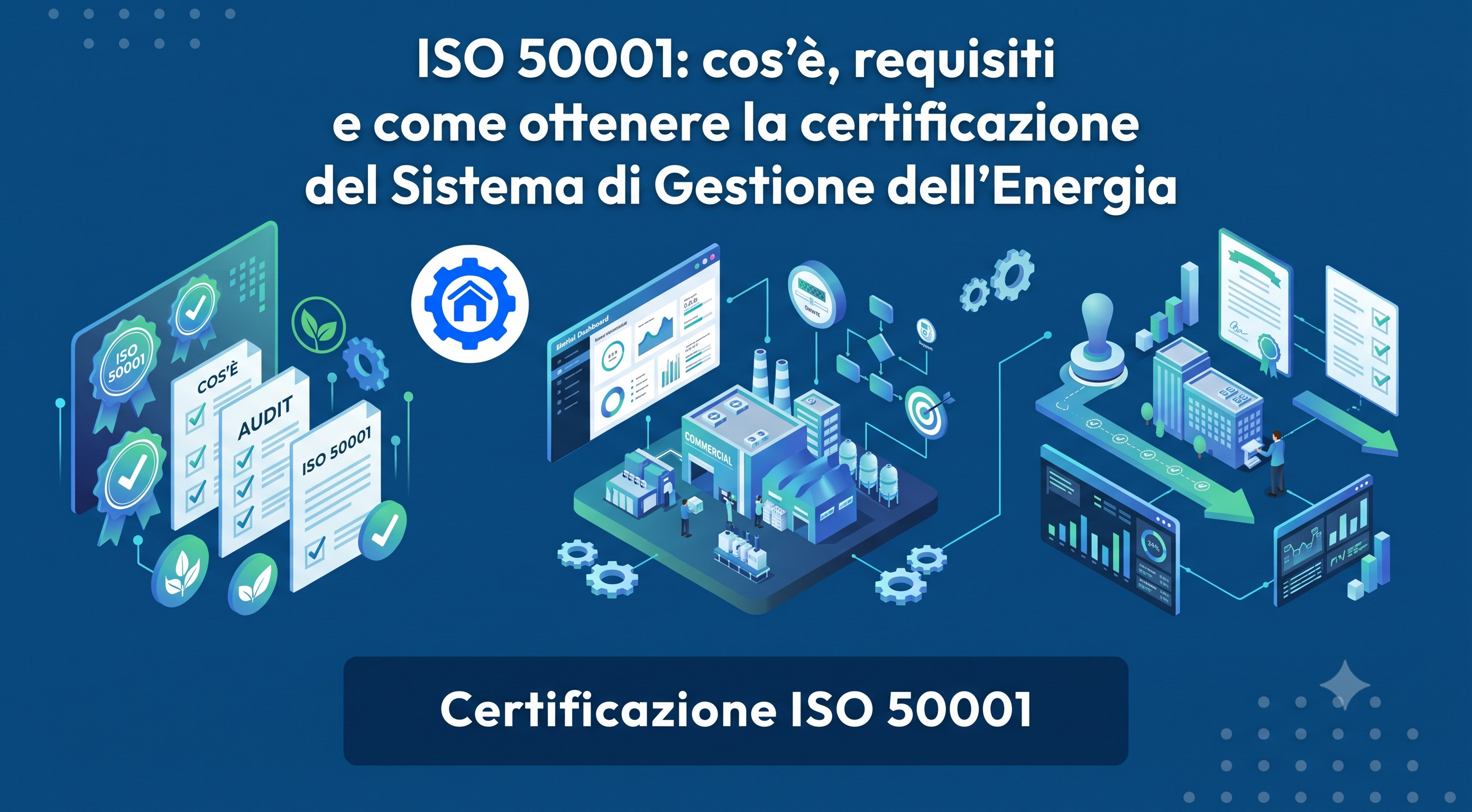
ISO 50001 is the international standard that defines the requirements for an Energy Management System (EnMS): a set of processes, data, and responsibilities through which an organization monitors its energy consumption and improves its energy performance over time.
Unlike an energy audit, which provides a snapshot of a situation, ISO 50001 requires a permanent mechanism to be established. This is also why, in companies where it genuinely works, certification is based on measured consumption data rather than a manual left in a drawer.
In brief:
- It is currently voluntary, but it exempts large enterprises from the energy audit obligation if the system includes a compliant audit.
- Under the transposition of the EED Directive, companies with annual consumption above 85 TJ are expected to be required to have a certified EnMS by 11 October 2027.
- The technical core consists of the energy baseline (EnB) and performance indicators (EnPIs): neither is reliable without measurement.
- Certification lasts three years, with annual surveillance audits conducted by an accredited body.
What is ISO 50001 and what does it actually require?
The current version is ISO 50001:2018, which adopted the high-level structure common to all management system standards (the same structure used by ISO 9001 and ISO 14001) and follows the Plan, Do, Check, Act cycle.
The difference from other certifications lies in a point that is often underestimated: the standard does not merely require a compliant system; it requires continual improvement in energy performance. Having procedures in order is not enough; figures must demonstrate that consumption improves under comparable conditions.
This shifts the focus from documentation to data. Organizations need to know how much energy they use, where they use it, and how consumption changes with production, weather, and space occupancy.
Who needs it and for whom it is about to become mandatory
This shifts the focus from documentation to data. Organizations need to know how much energy they use, where they use it, and how consumption changes with production, weather, and space occupancy.
Article 8 of Legislative Decree 102/2014 provides that the energy audit obligation does not apply to large enterprises that have adopted management systems compliant with EMAS, ISO 50001, or EN ISO 14001, provided that the system includes an energy audit compliant with Annex II of the decree.
Article 8 of Legislative Decree 102/2014 provides that the obligation to conduct an energy audit does not apply to large enterprises that have adopted management systems compliant with EMAS, ISO 50001, or EN ISO 14001, provided that the system includes an energy audit compliant with Annex II of the decree.
| Company's annual energy consumption | Requirement envisaged | Indicated deadline |
|---|---|---|
| Above 85 TJ | Certified Energy Management System (ISO 50001) | 11 October 2027 (deadline in the draft decree) |
| Between 10 and 85 TJ | Periodic compliant energy audit | 11 October 2026 (deadline in the draft decree) |
Pay attention to how this table is interpreted: at the time of writing, the Italian decree transposing the directive has not yet been published, so thresholds and deadlines must be verified once it appears in the Official Gazette. According to ENEA analyses cited by FIRE, the obligation would affect more than one thousand organizations.
Italy starts from a strong position in terms of adoption: it ranks second worldwide for the number of ISO 50001-certified companies and fourth for the number of sites, according to FIRE data for the end of 2023. However, the total remains small compared with the country's productive base.
Germany leads the ranking for a very practical reason: it has linked certification to access to incentives for energy-intensive businesses.
The standard's requirements, explained
| Requirement | What the standard requires | What is needed in practice |
|---|---|---|
| Energy policy | Formal commitment from management to improve energy performance | A concise policy aligned with real objectives, signed by those who decide on budgets |
| Energy review | Analysis of energy uses and consumption, identifying significant energy uses | Consumption data broken down by utility, not just bills |
| Energy baseline (EnB) | A quantitative reference point against which improvements are measured | A representative period that accounts for the factors affecting consumption |
| Energy performance indicators (EnPIs) | Indicators that measure energy performance | Normalized indicators that can be compared over time, rather than absolute consumption figures |
| Objectives and action plans | Measurable targets with assigned responsibilities and deadlines | Measures with expected savings, an assigned owner, and a verification method |
| Skills and roles | Competent people and clearly defined responsibilities | Often an energy manager or an EGE, either internal or external |
| Procurement and design | Energy criteria in purchasing and new installations | Efficiency specifications in tender documents, not just the lowest price |
| Data collection and analysis | A plan for measuring key characteristics | A measurement plan with defined points, frequencies, and responsibilities |
| Internal audits and management review | Periodic verification of the system and its performance | Up-to-date data ready for review, not reconstructed the week before the audit |
The technical core: baseline and EnPIs
This is the point on which auditors tend to be particularly demanding. The energy baseline (EnB) is the reference level of consumption against which improvements are measured; EnPIs (Energy Performance Indicators) are the indicators used to measure performance.
The typical problem is that absolute consumption figures do not tell the whole story: if production falls or the winter is mild, consumption decreases even if nobody has taken action. EnPIs must therefore be normalized against the factors that genuinely affect consumption, such as production volumes, heating degree days, opening hours, and occupied floor area.
Dedicated supporting standards are available for developing baselines and indicators, such as ISO 50006. ISO 50015 is the reference for verifying savings, in line with the logic of the IPMVP protocol discussed in our guide to building energy efficiency.
The measurement plan: where the real work happens
The standard requires organizations to define how they will collect the data needed to monitor key characteristics. The operational tool for this is UNI CEI EN 17267, which establishes how to design an energy measurement and monitoring plan: measurement points, quantities, frequency, data retention, and adjustment factors.
The difference between an EnMS that works and one that merely survives audits is clear. Utility bills alone provide a monthly figure for each site: enough to complete a form, but useless for understanding what is happening.
With submetering, using smart meters and sensors on the main utilities, EnPIs can be calculated automatically and anomalies can be detected as they occur.
Indeed, in ENEA's assessments of mandatory energy audits submitted in November 2025, around 70% of non-conformities concerned the monitoring strategy itself: unspecified measurement points, campaigns that were too short, and missing load profiles.
How to obtain certification
The process follows the traditional management-system approach, with a more substantial technical component:
- Initial analysis and energy review. Consumption data is collected, significant energy uses are identified, and the baseline is established.
- System design. Energy policy, objectives, roles, procedures, measurement plan, and action plans.
- Implementation and data collection. Sufficient historical data is needed to demonstrate performance; this stage extends the timeline if measurement is not already in place.
- Internal audit and management review. Before the certification body arrives, the system is checked internally.
- Certification audit. Conducted in two stages: document review and on-site verification.
- Issuance of the certificate, valid for three years, with annual surveillance audits followed by renewal.
The certification body must be accredited; in Italy, this is done by Accredia, in accordance with ISO 50003, which also establishes how audit days are calculated based on energy consumption and organizational complexity. This is why costs cannot be estimated as a flat fee: they depend on the number of sites, energy carriers, and technical-system complexity, not on turnover.
The mistakes we see most often
- A system built for the audit rather than for the company. Procedures are well written, but data is collected manually the month before the assessment: it passes the audit once but delivers no savings.
- Unnormalized EnPIs. Indicators based on absolute consumption deteriorate as soon as production increases and are difficult to defend before an auditor.
- No submetering. Utility bills may be enough to obtain certification, but not to understand where to intervene; the system becomes a compliance exercise.
- Objectives without an owner. An action plan without a named person responsible for each measure remains a list of good intentions.
- Data in separate spreadsheets. This works for one site but becomes unmanageable across a property portfolio or multiple plants.
ISO 50001 in tertiary-sector buildings
Much of the material available on ISO 50001 is written with industry in mind, where energy use is tied to production lines and machinery. Organizations managing offices, accommodation facilities, healthcare facilities, schools, or retail networks face a different situation and need to take a few additional considerations into account.
- The scope must be decided in advance. A system can cover the entire organization or selected sites. For a property portfolio, it is worth starting with the sites that have the greatest impact and are representative, rather than simply the easiest ones.
- EnPIs are normalized differently. There is no unit of production to divide consumption by: instead, use floor area, opening hours, occupancy, occupied rooms, or degree days. Choosing the indicator is a strategic decision because it will be discussed at every audit.
- Comfort is a constraint, not a free variable. In a hospital or hotel, savings cannot come at the expense of indoor conditions: temperature, humidity, and air quality must be monitored alongside consumption.
- Management is often outsourced. If maintenance and plant operation are entrusted to third parties, requirements for competence, operational control, and procurement must be translated into contractual clauses; otherwise, they remain on paper.
- Sites can be compared with one another. This is an advantage for organizations with many similar properties: internal benchmarking across stores or branches identifies anomalous buildings much earlier than individual analyses.
The tools: the management system relies on data
A certified EnMS requires three ongoing activities: measuring, calculating indicators, and demonstrating improvement. These are precisely the functions of an energy management platform, known in technical terminology as an EMS.
UTwin's energy management software covers this entire chain: collecting data from smart meters and IoT sensors for energy, water, gas, and environmental parameters; storing historical data on a cloud platform; displaying it on the building model; and using AI algorithms to flag anomalies and remotely adjust systems according to outdoor weather and occupancy.
The integrated maintenance software (CMMS) completes the process required by the standard: a corrective action does not remain a notification but becomes an assigned, dated, and traceable task—evidence ready for an audit. To help compare available solutions, we have prepared an overview of energy management software and a guide to energy consumption monitoring.
Frequently asked questions
- Is ISO 50001 certification mandatory?
Not at present; it is voluntary. However, it has two regulatory effects: it exempts large enterprises from the energy audit obligation when the system includes an audit compliant with Annex II of Legislative Decree 102/2014, and the transposition of the EED Directive 2023/1791 is expected to make it mandatory for companies with annual consumption above 85 TJ, with a deadline indicated as 11 October 2027.
- What is the difference between ISO 50001 and an energy audit?
An energy audit is a periodic analysis that provides a snapshot of consumption and identifies possible measures. ISO 50001 is a permanent management system: it includes the analysis but adds a policy, objectives, responsibilities, continuous monitoring, and verification of improvement.
- How long does certification last, and what does maintaining it involve?
The certificate is valid for three years, with annual surveillance audits and a renewal audit at the end of the period. Maintaining certification means keeping data, indicators, and action plans up to date and demonstrating continual improvement in energy performance.
- What is the difference between ISO 50001 and ISO 14001?
ISO 14001 covers the management of environmental aspects as a whole, while ISO 50001 focuses on energy and explicitly requires improvements in energy performance. They share the same high-level structure and therefore integrate well, but neither replaces the other.
- Is an energy manager required to obtain certification?
The standard does not require a specific job title; it requires defined skills and responsibilities. In practice, the role is assigned to an energy manager or an Energy Management Expert, either internal or external to the organization.
Where to start
Before starting a certification project, it is worth checking just one thing: how well the company currently measures its consumption.
If the available data consists only of monthly utility bills, the first step is not to write procedures; it is to install submeters on the main utilities and collect several months of historical data. With data in place, the rest of the system can be built on a solid foundation. Without it, the organization certifies a process that does not deliver savings.


Informative Material