

 ITA
ITA  ENG
ENG SPAN
SPAN FR
FR NL
NL GER
GER FI
FI

 ENG
ENG  ITA
ITA BMS (Building Management System): what it is, how it works, which systems are on the market, and the “light” alternatives
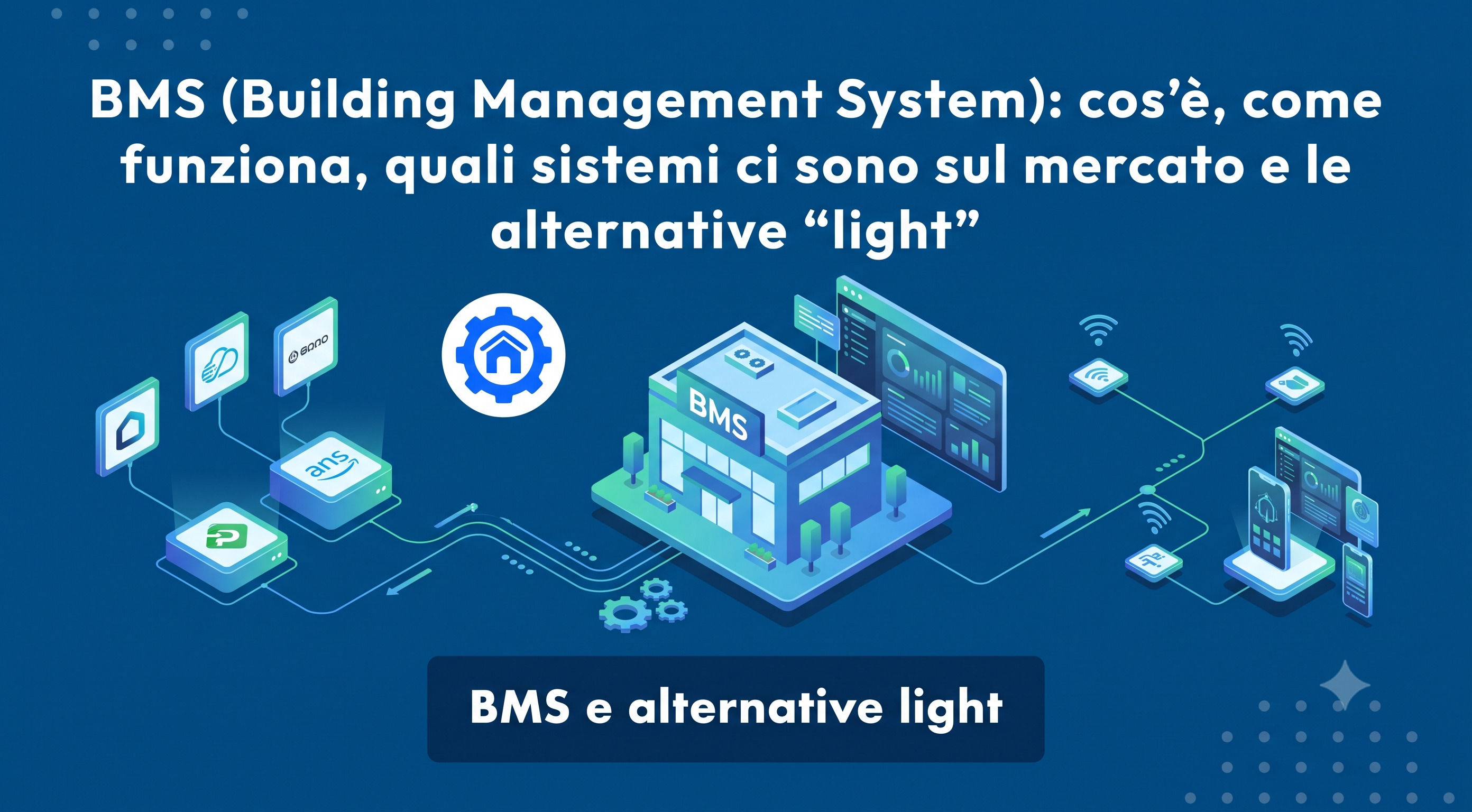
A BMS (Building Management System) is the centralised system that supervises and controls a building’s systems: heating and cooling, lighting, energy and security. This guide explains how it works, how it differs from EMS and building automation, which major systems are on the market, how much they cost, and when it makes sense to consider a cloud-based light BMS.
In brief:
- A BMS does not simply observe building systems; it regulates them. This is what distinguishes it from a monitoring system.
- The traditional-system market is served by a small number of major groups, with platforms designed for complex buildings.
- Industry cost ranges of €300–€1,200 per control point explain why small and medium-sized buildings often cannot justify these systems.
- Light BMS solutions serve these properties: cloud-based, wireless sensors and no cabling.
- Where a BMS already exists and works, integration delivers more value than replacement.
What is a BMS and how does it work?
A building management system is a platform for supervising, controlling and remotely managing a building’s installations. Its job is to make systems that were originally separate—heating, ventilation and air conditioning, lighting, electrical distribution, fire safety and access control—communicate and operate through a single interface, according to comfort, safety and efficiency requirements.
The classic BMS architecture has three levels:
- Field level: sensors and actuators collect physical data (temperature, humidity, CO2 and presence) and execute commands for valves, dampers, fans and light fittings.
- Automation level: controllers (DDCs, or Direct Digital Controllers) process field data, compare it with setpoints and make operational decisions, even independently of the supervisory system.
- Supervisory level: management software presents data, alarms and historical records to operators, who use it to change setpoints, schedules and control logic.
This ability to act on building systems, rather than simply observe them, is what defines a BMS. It is worth establishing this distinction from the outset because it is the key difference between a BMS and other systems.
BMS, building automation, EMS and BEMS: what is the difference?
The terms often overlap, but the essential distinction is simple: monitoring is not control. An energy monitoring system collects data and generates alerts; a BMS acts on building systems by switching them off or on and adjusting their operation. With this distinction in mind, the terminology becomes clearer:
- Building automation is the overall field: all technologies that automate a building’s operation, from a single thermostat to a complete smart building.
- A BMS is the platform that supervises and controls a building’s technical systems as a whole.
- An EMS (energy management system) focuses on energy data: it measures, analyses and reports consumption. More details are available in our EMS guide.
- A BEMS (building energy management system) is a BMS specifically focused on energy management—in effect, a convergence of the two domains.
In commercial practice, the boundaries are less clear-cut: many advanced EMS platforms now include automation, and all major BMS platforms include energy modules. The right question is not “What label does this system have?” but “What can it control, and which systems can it control?”
What are the main BMS systems on the market?
The commercial-building BMS market is dominated by large international automation groups. The table summarises the platforms most frequently found in specifications and existing buildings in Italy; each system name links to our dedicated in-depth guide.
| System | Positioning | Key protocols | Typical buildings |
|---|---|---|---|
| Desigo CC Siemens | Modular platform that the manufacturer says is suitable for buildings of any size; on-premises core with native cloud connectivity (Building X); scales up to 150,000 objects per system | BACnet and BACnet/SC, Modbus, KNX, OPC UA | Hospitals, campuses, headquarters and data centres |
| EcoStruxure Building Operation Schneider Electric | Open BMS within the EcoStruxure platform; analytics and energy services delivered through the cloud layer | BACnet, LonWorks, Modbus, MQTT | Multi-tenant offices, healthcare facilities and data centres |
| EBI and Niagara Honeywell | EBI integrates automation, security, fire safety and access control across large complexes; Niagara (Tridium) is a vendor-neutral integration framework also used by third parties | BACnet, Modbus, LonWorks and many others | Airports, hospitals and industrial campuses |
| Cylon and i-bus KNX ABB | Cylon for HVAC and energy in commercial buildings; i-bus KNX for lighting and room automation, integrable via a BACnet/IP gateway | BACnet, Modbus, KNX | Commercial buildings, hotels and tertiary-sector buildings |
| modulo and Vision Center SAUTER | Universal management-level supervision with a certified BACnet client; the modulo family serves the automation level | BACnet, OPC UA and MQTT (Vision Center); Modbus, M-Bus and LON (automation level) | Multi-system tertiary-sector and healthcare buildings |
All these systems share one trend: their architecture is becoming hybrid. Control remains on-premises for obvious reliability reasons, while analytics, maintenance and optimisation are moving to cloud services. This implicitly recognises that value has shifted from control itself to the intelligent use of data.
How much does a traditional BMS cost?
For a commercial building in Europe, typical costs range from €300 to €1,200 per “turnkey” control point (device, controller, cabling, integration and commissioning), or from €8 to €25 per square metre for the complete system.
For a 5,000-square-metre office building, this means an investment of €40,000 to €125,000, plus annual maintenance (typically 1–3% of the invested capital) and system-integrator fees for every change to the control logic.
However, another cost rarely shown in quotations is underutilisation. In our energy-efficiency projects, this is by far the most common problem: BMS platforms costing tens of thousands of euros end up serving as alarm panels in control rooms, with control logic left unchanged since commissioning years earlier and optimisation features never activated. Industry reports indirectly confirm this: analytics, automatic fault diagnosis and data-driven optimisation are cited as future growth drivers precisely because they remain underused today.
Meanwhile, the market is growing: major analysts estimate the global building-automation market at over $100 billion in 2025, with annual growth rates of 9–12%, and the European market at around €20 billion. Growth is driven by energy costs, European efficiency regulations and ESG pressure on real-estate portfolios.
What is a light BMS and when does it make sense?
A light BMS is a cloud platform that provides the essential functions of a building management system—monitoring, automation and remote control—without the infrastructure required by a traditional system. Its defining features include
wireless IoT sensors that can be installed without dedicated cabling or interrupting operations, artificial intelligence that adjusts building systems according to outdoor weather and actual space occupancy, and a native CMMS that links energy data to maintenance.
Light BMS solutions are particularly suited to buildings where a traditional BMS has never been economically justifiable: retail outlets and supermarkets, hotels, care homes and smaller corporate offices.
In these buildings, the cabling and engineering required for a traditional system cost too much relative to the property’s value, leaving the buildings managed manually and subject to the resulting waste. For these building types, CAPEX savings compared with a traditional BMS can reach 70%.
This is the approach behind UTwin’s energy management software: a fully cloud-based platform combining monitoring of energy, water, gas and environmental parameters with AI automation and a building digital twin, alongside the direct supply of smart meters and sensors.
Light BMS and traditional BMS: alternative or integration?
A common question is whether a light BMS can replace a traditional BMS. The honest answer is: it depends on what is already installed in the building.
Where a BMS already manages complex systems, replacing it rarely makes sense; the value lies in integration. A light BMS builds on the existing system and adds what is missing:
continuous data readings, remote automation, AI-powered optimisation and integration with maintenance. In several projects, we have integrated UTwin with existing BMS installations specifically to enable remote automation of systems that the BMS had controlled locally for years.
One documented example is integration with Schneider Electric’s EcoStruxure: BMS data flows in real time into UTwin’s digital twin, and the same platform enables remote actions such as switching off lighting and HVAC or setting automatic rules based on outdoor weather and space occupancy.
The integration was validated in a pilot project at a Schneider Electric site and is available to all customers; we announced it here. Technically, the connection uses the standard protocols exposed by the BMS. The exact scope—what data is available and which commands can be issued—is defined for each project together with the system manager.
Where no BMS exists, and the building is too small to justify one, a light BMS is a practical alternative: it brings system control to buildings that previously had only a monthly utility bill. It is not a compromise; for a portfolio of small and medium-sized buildings, it is simply a solution proportionate to the problem.
How to choose: questions to ask
Before comparing products, it is worth answering a few questions about the building and the organisation:
- System complexity: how many systems need to be controlled, and which ones? Complex heating plants and data-centre rooms justify a structured BMS; standard installations generally do not.
- What is already in place: is there a BMS? Is it actively used, or does it only display alarms? Before investing in a new system, it is often worth reactivating and integrating the existing one.
- Who will use it: an in-house facilities team based in the building, or a centralised team managing multiple sites remotely? The answer helps determine whether an on-premises or cloud solution is more suitable.
- Interoperability: does the system support standard protocols such as BACnet, Modbus and KNX? A closed system today can become a cost tomorrow.
- Cost model: a significant CAPEX investment with annual maintenance, or a cloud subscription that includes updates? Evaluate it over five or ten years, not just the first year.
- Main objective: comfort and system operation, or consumption reduction and reporting? In the latter case, include EMS platforms in the comparison, using our EMS guide to compare platforms.
Frequently asked questions
- What is the difference between a BMS and a light BMS?
A traditional BMS is an on-site, wired system designed to control complex installations. A light BMS is a cloud platform with wireless sensors that provides essential functions—monitoring, automation and remote control—with much lower investment and installation times.
They are not competing solutions: a traditional BMS remains the choice for complex buildings, while a light BMS serves buildings where a traditional system has never been economically justifiable. - What is the difference between a BMS and SCADA?
SCADA (Supervisory Control And Data Acquisition) refers to a family of supervisory and control systems developed for industrial processes and infrastructure, including electricity and water networks, production lines and treatment plants.
The principle is the same as for a BMS—collecting field data, centralised supervision and actuator control—but the object being controlled is different: SCADA manages a process, while a BMS manages a building’s systems, with control logic focused on comfort, energy and operations. - How much does a BMS cost?
For a commercial building, typical costs range from €300 to €1,200 per control point, or €8 to €25 per square metre, including installation, plus annual maintenance typically amounting to 1–3% of the investment. A cloud-based light BMS significantly reduces the initial investment component, replacing much of it with a subscription fee.
- Does a BMS save energy?
Yes, but not by itself. Savings come from control logic—schedules, dynamic setpoints and automatic shutdowns—and from the ability to detect deviations in consumption. A BMS that is installed and then left to display alarms does not save energy: this is why actual use of the system matters more than its technical specifications.
- Is a BMS necessary for a small building?
A traditional BMS is rarely worthwhile for a small building because cabling and engineering costs do not pay for themselves. However, this is where a light BMS delivers the greatest value:
for retail outlets, supermarkets, hotels, care homes and smaller corporate offices, a cloud platform with wireless sensors such as UTwin provides monitoring and automation with an investment up to 70% lower than a traditional BMS.
Where to start
Whether the building already has an underused BMS or has never had one, the starting point is the same: understand how it actually consumes energy, system by system and hour by hour. These data show whether it is better to reactivate the existing system, integrate it or start with a cloud platform. Everything else, including brands and acronyms, comes afterwards.


Informative Material