

 ITA
ITA  ENG
ENG SPAN
SPAN FR
FR NL
NL GER
GER FI
FI

 ENG
ENG  ITA
ITA Alternatives to ABB building automation: the light BMS for remote control
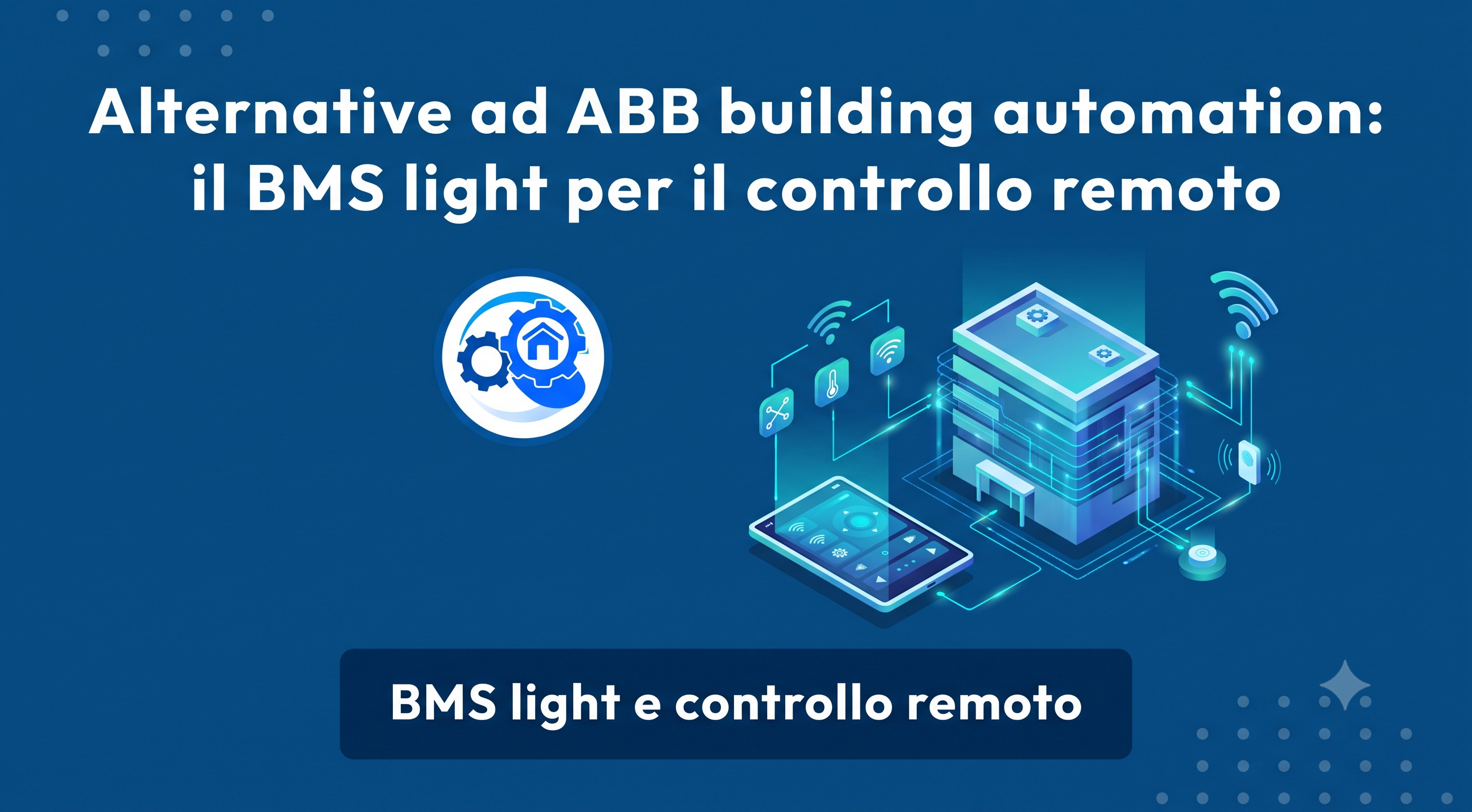
In building automation, ABB operates at two levels: Cylon for BMS focused on HVAC and energy, and i-bus KNX for lighting and room automation. These are reliable, widely used technologies, but they cover a specific scope:
Those looking to manage the energy performance of a building portfolio or control systems remotely often need something that sits above or alongside these systems. This guide explores the available alternatives and integration options.
For transparency: UTwin, which you will find among the alternatives, is our software and is not a direct competitor to major building automation names such as ABB. It serves properties where a full BMS has never been justifiable and integrates with existing systems where remote control is needed.
In brief:
- ABB covers two different levels: Cylon for BMS focused on HVAC and energy, and i-bus KNX for lighting and room automation.
- Room automation does not answer the key question: how much energy the building consumes and where it is being wasted.
- Portfolios with diverse installations need a single cloud-based management layer more than a separate engineering project for every site.
- Where ABB automation is already installed, completing it is almost always better than replacing it.
What ABB does in building automation (and what it does well)
According to ABB documentation, its building offering is divided into two product families with different roles:
- Cylon: the BMS line that joined the group through the 2020 acquisition, focused on controllers and supervision for HVAC and energy in commercial buildings.
- i-bus KNX: ABB's implementation of the open KNX standard, widely used for lighting, blinds and room automation in hotels and commercial buildings; integration with higher-level BMS platforms typically takes place through a BACnet/IP gateway.
Its real strength is its widespread presence: ABB components and standards are found in a huge number of European buildings, often installed by local electricians and system integrators. This is also why the usual question is not how to replace them, but what to build on top of them.
When it makes sense to consider an alternative
The most common scenarios involve needs that these systems do not cover on their own:
- Room automation is in place, but energy management is missing. A KNX system controls lights and blinds but does not show how much energy the building consumes or where it is wasted. That requires multi-utility monitoring and automation based on climate and occupancy.
- The building does not justify a full BMS. In shops, supermarkets, hotels, care homes and smaller offices, the engineering and cabling required by a traditional system can cost more than the value it delivers.
- The portfolio needs to be managed remotely. Multiple sites with different systems—KNX at one location, an old BMS at another and nothing at a third—need a single cloud-based management layer rather than a separate engineering project for each site.
- Every change requires the system integrator. If changing a schedule or control logic requires an external visit, the system can remain stuck with its initial configuration.
Comparing the alternatives to ABB
The alternatives fall into two groups: other major BMS platforms for complex buildings, and light BMS solutions for buildings outside that category. Each system name links to our dedicated in-depth guide; the full overview is available in the BMS guide.
| System | Profile | When to choose it |
|---|---|---|
| Desigo CC Siemens | Modular platform for highly complex buildings, with one of the broadest protocol ranges on the market, including KNX | Hospitals, campuses, headquarters and data centers with critical systems |
| EcoStruxure Building Operation Schneider Electric | Open BMS within the EcoStruxure platform, with native BACnet, LonWorks and Modbus support and cloud analytics | Complex buildings, especially where the electrical ecosystem is already Schneider |
| modulo and Vision Center SAUTER SAUTER | Universal multi-protocol automation and supervision at management level | Commercial and healthcare buildings with multiple systems across Europe |
| UTwin (light BMS) | Cloud platform with supplied wireless sensors, AI for remote system control, CMMS and digital twin | Small and medium-sized buildings and multi-site portfolios where a full BMS is not justified |
The light alternative: when a full BMS is not justified
For buildings that will never need a full BMS, a light BMS such as UTwin starts from a different premise: the sensors come with the software. Smart meters and wireless sensors can be installed without cabling or operational downtime.
The platform is entirely cloud-based, AI adjusts systems according to outdoor weather and actual space occupancy, and the native CMMS connects energy consumption with maintenance.
For locations such as retail stores, supermarkets, hotels, care homes and smaller offices, the investment can be up to 70% lower than with a traditional BMS, and the solution also works in buildings with no smart building infrastructure yet.
Alternative or integration? UTwin on top of ABB systems
Where ABB automation is already in place, the goal is not to replace it but to complete it. In several projects, we have integrated UTwin with existing BMS platforms to add missing capabilities: continuous energy data readings, remote automation based on climate and occupancy, and links between anomalies and work orders.
In buildings with KNX systems but no actual BMS, the light platform works in parallel: room automation continues to manage the electrical system, while UTwin adds multi-utility monitoring and energy management without altering the existing installation. The exact scope of integration, including data and commands, is defined for each project.
How to choose
The approach that works best in our projects is to distinguish between the three levels of the problem, which are often confused:
- Room automation, system control or energy management? KNX addresses the first, BMS platforms the second, and energy management platforms the third. These are different needs, and the right answer may be a combination.
- What do you already have in place? An honest inventory of systems, protocols and maintenance responsibilities is worth more than any demo. There is usually existing value to make use of before buying anything else.
- Who will manage the system every week: an on-call system integrator or your own facility team? The answer helps determine whether an engineering project or a self-managed cloud platform is more suitable.
- Over what period are you comparing costs? Compare CAPEX and cabling with subscription fees and wireless sensors over five or ten years, keeping the scope equivalent.
Frequently asked questions
- What is the difference between Cylon and i-bus KNX?
Cylon is ABB's BMS line: controllers and supervision for HVAC and energy in commercial buildings. i-bus KNX is ABB's implementation of the KNX standard for electrical system automation, including lighting, blinds and room scenarios. They operate at different levels and often coexist in the same building.
- Is a KNX system enough as a BMS?
No: KNX manages room automation (lights, blinds and scenarios), but it is not a building management platform. It does not monitor consumption across multiple utilities, compare sites or link anomalies to maintenance. Those functions require a higher-level solution, such as a BMS or light platform.
- I have a KNX system: can I add energy monitoring without replacing anything?
Yes: a light platform with wireless sensors works alongside the existing installation without modifying it. Room automation continues to operate as before, while monitoring for energy, water, gas and environmental conditions is added using dedicated sensors installed within days.
- Can I keep my ABB BMS and add UTwin?
Yes: the BMS continues to control local systems, while UTwin integrates with it and adds multi-utility monitoring, remote AI-driven automation and maintenance links. The technical scope of integration is defined project by project with the team managing the system.
- Are ABB systems suitable for small buildings?
i-bus KNX is suitable and widely used even in small buildings, but it covers electrical automation rather than energy management. A full BMS is rarely justified below a certain scale, which is where a light BMS becomes the proportionate option.
Where to start
Start by taking inventory of what is already installed: where KNX is present, where a BMS exists and what data it provides, and where there is no system at all. Then clarify your actual goal: automating rooms, controlling building systems or managing energy across a portfolio. Once this is clear, choosing between ABB, alternatives and integrations becomes much easier.


Informative Material