

 ITA
ITA  ENG
ENG SPAN
SPAN FR
FR NL
NL GER
GER FI
FI

 ENG
ENG  ITA
ITA BMS and building automation: what they are and why they are evolving toward the Digital Twin
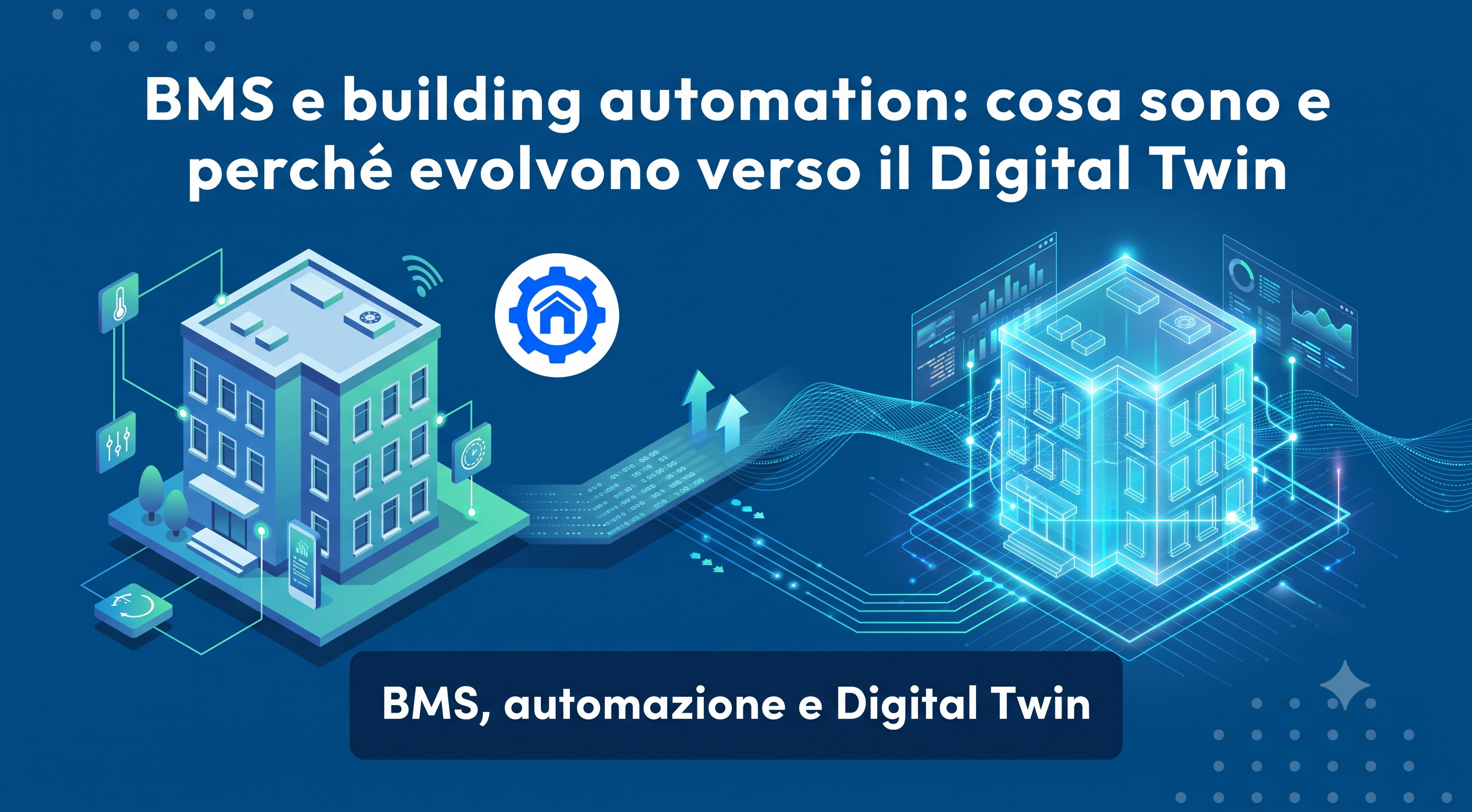
Building automation refers to the technologies that automate the operation of a building's systems: heating and cooling, lighting, ventilation, access control, and security.
The BMS is the platform that manages them. The Digital Twin is the next step, where the building is not only controlled but also represented, analysed, and simulated. These are three different levels of digitalisation, and it is worth understanding which one is actually needed.
In brief:
- Building automation is the field; the BMS is the platform that manages it.
- Field protocols determine how easily a building can be integrated in the future: BACnet dominates the commercial market.
- The UNI EN ISO 52120 standard classifies automation from D to A, and the EPBD makes it mandatory above certain system capacities.
- A Digital Twin is not a 3D model: it requires real-time data and bidirectional data flow, and for many buildings it is still more than they need.
What is building automation and how does it differ from a BMS?
Building automation is the overall technological field. The BMS (Building Management System) is the system that supervises and controls building systems as a whole: this is covered in detail in the guide to BMS systems on the market.
The architecture has remained the same for decades and is organised into three levels:
- Field level: sensors and actuators—the devices that measure (temperature, humidity, CO2, occupancy) and those that act (valves, dampers, fans, contactors).
- Automation level: controllers that process field data, compare it with setpoints, and decide what to do.
- Supervisory level: software that presents data, alarms, and historical records to operators and allows schedules and control logic to be changed.
In practice, the key difference is something else: an automation system acts on building systems, while a monitoring system observes consumption. These functions complement each other and are often confused, which can lead to buying the wrong solution.
Protocols: how building systems communicate with each other
A building has systems from different suppliers, installed in different years. What determines whether they can work together is not the brand, but the communication protocol.
| Protocol | Typical role in the building | What to know |
|---|---|---|
| BACnet | Supervisory backbone: connects major equipment and entire buildings | Developed by ASHRAE for buildings, it is the most widely used standard in commercial building automation, with estimated global market shares ranging from 60% to 77% |
| Modbus | Field devices: meters, inverters, generator sets, industrial sensors | Simple and widely used, but without native security and with manual configuration |
| KNX | Room-level control: lighting, blinds, control panels | Very common in Europe and reliable, but configuration hardware and software can be expensive |
| LonWorks | Legacy systems where wiring is constrained | Declining: components and technicians are becoming increasingly difficult to find |
There is one practical recommendation, more important than any product comparison: check that the system supports open protocols. A system that communicates only with the platform of the supplier that installed it becomes a recurring cost as soon as the service provider changes.
How automated is a building: efficiency classes
Automation levels are not vague concepts; there is a scale. The UNI EN ISO 52120 standard classifies building automation and control systems into four efficiency classes, from D (inefficient systems) to A (high efficiency, with dynamic regulation and advanced functions).
From a regulatory perspective, the EPBD requires non-residential buildings to be equipped with automation and control systems, where technically and economically feasible, when system capacity exceeds 290 kW, with the threshold falling to 70 kW by the end of 2029.
For many commercial properties, therefore, the question is no longer whether to automate, but which level and technology to choose.
Why automation alone is not enough
This is the issue we encounter most often in the field. A BMS that has been installed and never updated tends to become little more than an alarm panel: it works and controls the systems, but nobody uses its data to make decisions.
The reason is that controlling and understanding are two different things. An automation system knows the current state of a valve; to determine whether that valve is costing more than it should, historical data, submetering, and comparison with external conditions are needed—that is, energy consumption monitoring and dedicated sensors.
This is why projects that start with control alone soon stall, while those that start with data continue to generate savings year after year.
What a building Digital Twin really is
Marketing has caused confusion here. A 3D building model is not a Digital Twin, nor is an up-to-date BIM model containing as-built information.
The reference definition, drawn from ISO 23247-1:2021, describes a digital twin as a system in which data flows continuously and bidirectionally between the physical object and its digital representation. NIST adds the purpose: to observe, diagnose, predict, and optimise in near real time.
In practical terms, a building digital twin requires four things:
- A geometric and information-rich building model, typically derived from BIM or from surveys and CAD floor plans.
- A continuous stream of real data from sensors and building systems.
- Bidirectionality: the model does not only receive data; it also enables action on building systems.
- Governance: someone must keep the model aligned with the real building over time.
The maturity scale
The most honest way to approach this is through progressive levels, using a widely adopted scale:
- Level 1: a static 3D model, the as-built BIM.
- Level 2: the model is enriched with historical operational data.
- Level 3: real-time data integration. This is where the term digital twin becomes appropriate.
- Level 4: predictive analysis of observed data.
- Level 5: closed-loop automation, with the model acting on building systems.
The difference between level 1 and level 3 lies entirely in the data, not the graphics. That is why many projects stall: the model exists, but the sensors do not.
When it is worthwhile and when it is not
It is worth being clear, especially because honesty on this topic is rare. In Italy, according to industry analyses, only around 15% of real estate companies have fully adopted digital twin solutions, while most remain at the assessment or pilot-project stage.
There are four decision criteria, and all must be met:
- Asset criticality. A hospital, data centre, or monitored historic building may justify the investment; a standard office much less so.
- Long useful life. A digital twin pays for itself during operation, not during construction.
- Existing data infrastructure. Without sensors and historical data, the digital twin remains a rendering.
- Organisational capacity. Someone needs to use the system every day, not just purchase it.
For most commercial buildings, the sensible approach is somewhere in between: an updated floor plan or as-built model, a monitoring platform using real data, and an appropriate level of automation. This already corresponds to level 2 or 3 on the scale, and it is where measurable savings begin.
What it is actually used for in a commercial building
Beyond definitions, the use cases that pay back the investment are few and recurring:
- Control based on actual occupancy. Heat, cool, and light spaces according to the number of people present, rather than a schedule decided years ago. This is the quickest-return measure among those described in the guide to building energy efficiency.
- Data-driven maintenance. A decline in performance becomes a scheduled intervention before it turns into a failure, with the equipment record already linked to the correct location in the building.
- Space management. Knowing which areas are used and how much they are used supports both energy management and property decisions, such as revising floor areas and layouts.
- Compliance and reporting. Keeping consumption, maintenance activities, and environmental conditions in one place simplifies audits, energy assessments, and certifications, as discussed in our guide to smart buildings.
- Management handovers. When the facility manager or maintenance provider changes, an updated model prevents the process from having to start from scratch.
How to get there in four steps
- Organise the asset register. Spaces, systems, and equipment: without this foundation, no data can be linked.
- Measure. Submeter the main utilities and install environmental sensors in critical areas, with readings every 15 minutes.
- Integrate existing systems. Use field protocols to recover and connect what is already there instead of replacing it.
- Add control logic and forecasting. Automate according to weather and occupancy, raise anomaly alerts and, when the data allows it, implement predictive maintenance.
Each step creates value on its own, and that is the difference compared with projects that try to reach level 5 in a single leap.
The tools: from model to data, all in one platform
UTwin was created specifically for this journey: the platform builds a building digital twin from CAD files or BIM models and connects it to real-world data.
The energy management software brings energy, water, and gas consumption, along with environmental parameters collected by smart meters and IoT sensors, onto the model. AI algorithms detect anomalies and remotely adjust systems according to outdoor weather and space occupancy.
The maintenance software (CMMS) is natively integrated, so an anomaly becomes a tracked work order linked to the correct object in the model.
Where a BMS already exists, the platform integrates with it and enhances its remote automation capabilities. Where a traditional BMS would not pay for itself, such as in retail outlets, supermarkets, hotels, care homes, and small offices, it works as a light BMS with CAPEX up to 70% lower than market systems.
Frequently asked questions
- What is the difference between building automation and a BMS?
Building automation is the set of technologies that automate the operation of building systems. The BMS is the platform that supervises and controls them centrally. In practice, building automation is the field, and the BMS is the tool.
- Is a BIM model required to have a Digital Twin?
A building model is needed, which can come from BIM but can also be created from CAD floor plans or surveys of the existing building. What makes the model a digital twin is not its geometry, but its continuous connection to real system data.
- Is BACnet or KNX better?
They serve different purposes. BACnet is the most widely used standard for supervising systems and entire commercial buildings, while KNX is commonly used for room-level control such as lighting and shading. Many buildings use both, connected through the supervisory platform.
- Is the Digital Twin only for large buildings?
For ordinary buildings, a complete digital twin with simulation and closed-loop automation is often excessive. A building model connected to consumption data and maintenance activities, however, is useful even for medium-sized and small properties and costs much less.
- What are the UNI EN ISO 52120 efficiency classes?
There are four levels, from D to A, which classify how efficient a building's automation and control system is. They also serve as a reference when checking regulatory requirements for automation in non-residential buildings.
Where to start
The right question is not whether a digital twin is needed, but where the building currently sits on the scale. An updated model without data has little value, and data without a model that locates it in space is worth less than it could be.
The step that unlocks both is always the same: measure the main building systems and connect that data to a representation of the building that someone keeps up to date.


Informative Material