

 ITA
ITA  ENG
ENG SPAN
SPAN FR
FR NL
NL GER
GER FI
FI

 ENG
ENG  ITA
ITA Maintenance plan: how is it done for systems and buildings? Examples, guide, regulations
Maintenance plan: definition and importance
A maintenance plan is a fundamental document for the efficient and safe management of buildings and systems. It serves to prevent failures, ensure the preservation of value over time, and ensure regulatory compliance. A well-structured plan allows for the optimization of costs, reduction of risks, and improvement of the sustainability of the entire real estate portfolio.
Reference regulations: what the law provides
The drafting of the maintenance plan is regulated by various Italian regulations, including:
- D.P.R. 554/1999, art. 40: defines the plan as a mandatory document in public works, consisting of a user manual, maintenance manual, and maintenance program.
- Technical Standards for Construction (NTC 2018): require a maintenance plan for structures, to be attached to the executive project.
- Procurement Code (D.Lgs. 36/2023): requires the preliminary plan already in the feasibility phase and the complete one in the executive project.
- UNI 11257:2007: provides guidelines for drafting the maintenance plan and program for buildings and systems.
- CAM Edilizia: introduces minimum environmental criteria and obligations for monitoring, digitalization, and sustainability.
Remember: the maintenance plan is mandatory for all new constructions, significant renovations, and public tenders.
Structure and contents of the maintenance plan
A complete maintenance plan consists of three main parts:
- User manual
- Describes the correct methods of use for buildings and systems.
- Indicates preventive actions to avoid damage and wear.
- Helps to recognize anomalies and signs of malfunction.
- Maintenance manual
- Lists ordinary and extraordinary maintenance activities.
- Specifies resources, materials, and skills required.
- Defines minimum performance and corrective actions in case of failure.
- Maintenance program
- Establishes the frequency of interventions and deadlines.
- Organizes periodic inspections and checks.
- Includes a detailed time schedule of activities.
Each section must be clear, updated, and easily accessible by all parties involved in the management.
How to draft a maintenance plan: operational phases
The drafting of a maintenance plan follows a structured process, which guarantees effectiveness and compliance:
- Data collection
- Analysis of projects, technical sheets, and manuals of buildings and systems.
- Identification of critical components and risk areas.
- Component analysis
- Assessment of the state of conservation and maintenance needs.
- Classification of intervention priorities.
- Definition of interventions
- List of preventive, corrective, and predictive activities.
- Determination of the necessary resources and responsibilities.
- Scheduling and monitoring
- Drafting of the time schedule and deadlines.
- Implementation of control and reporting tools.
Digitalization facilitates data collection, collaboration between designers, managers, and maintainers, and the continuous updating of the plan.
Practical examples: application on buildings and systems
To better understand how a maintenance plan is applied, here are two concrete examples:
- Residential building
- Data collection on structures, roofs, water, and electrical systems.
- Scheduling of periodic inspections on the roof, facades, and elevators.
- Management of ordinary maintenance (filter cleaning, system verification) and extraordinary maintenance (fault repair, component replacement).
- Electrical system
- Drafting of a control register with deadlines (at least every 3 years).
- Verification of compliance with CEI standards and the 'Control Decree'.
- Documentation of inspections, tests, and interventions performed.
A well-applied plan prevents failures, reduces costs, and ensures the safety of users and operators.
Digital tools and innovation in maintenance
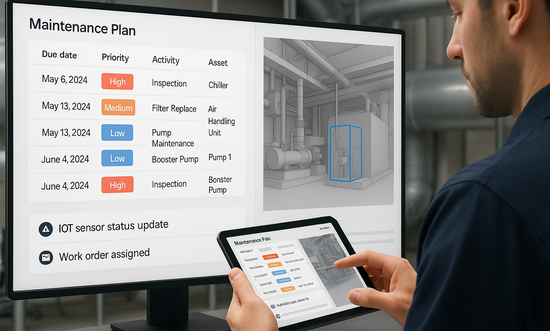
Digital innovation has revolutionized maintenance management. Today, thanks to specialized software and digital twins, it is possible to:
- Centralize all information on buildings and systems in a single platform.
- Monitor in real-time the status of components and systems via IoT sensors.
- Automate intervention scheduling and report generation.
- Facilitate collaboration between designers, managers, and maintainers.
- Reduce errors and oversights thanks to notifications and activity traceability.
BIM and CMMS (Computerized Maintenance Management System) are key tools for modern, efficient maintenance that complies with regulations.
Example of a digital solution: how a platform can support maintenance
A maintenance management software allows you to create, update, and consult the plan quickly and easily. Key features include:
- Integration with BIM models and IoT data for a complete and updated view.
- Centralized management of documents, deadlines, and interventions.
- Real-time collaboration among all parties involved.
- Traceability of activities and historical archiving of interventions.
Adopting a digital platform means simplifying management, reducing risks, and ensuring compliance with the latest regulations.
Best practices for an effective maintenance plan
- Draft the plan already in the design phase and update it regularly.
- Involve all parties (designers, managers, maintainers) in the definition and implementation.
- Use digital tools to monitor, document, and improve activities.
- Verify regulatory compliance and adopt sustainability criteria.
A well-structured maintenance plan is the key to safer, more efficient, and longer-lasting buildings and systems.


Informative Material